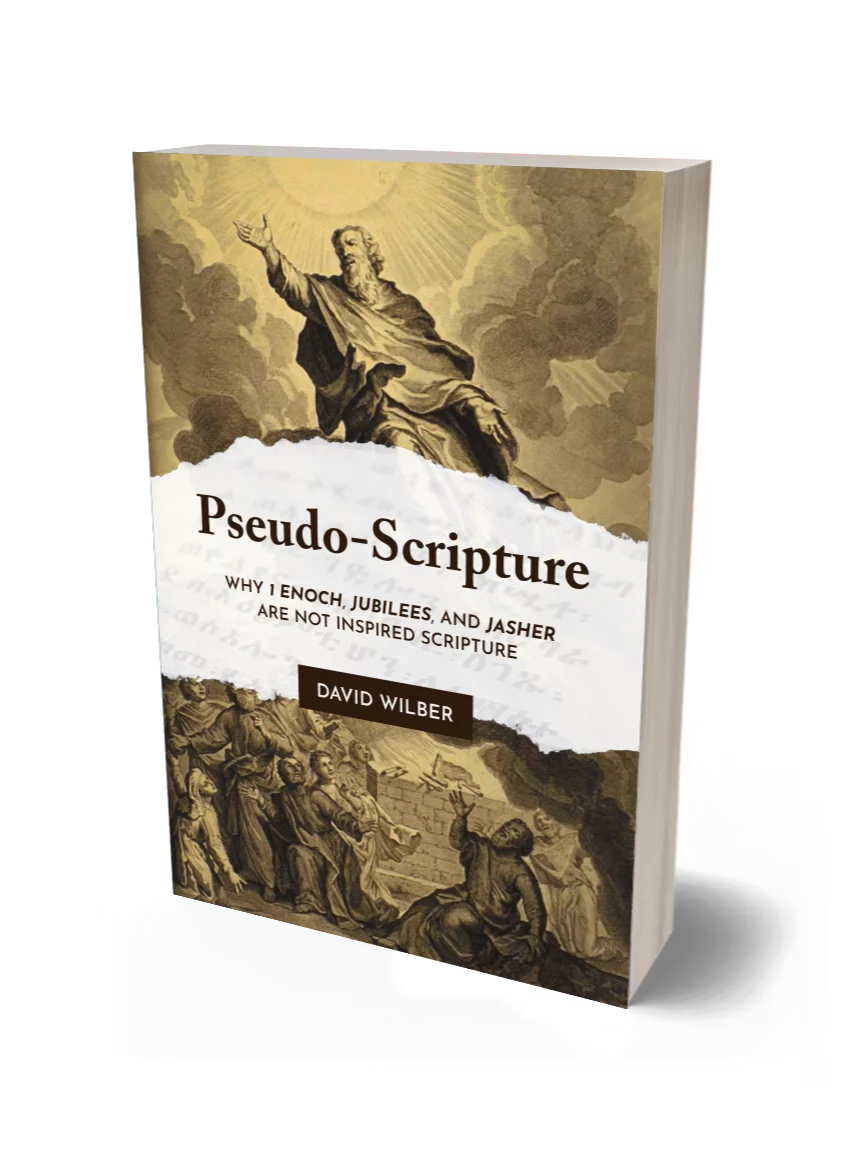
Pseudo-Scripture: Why 1 Enoch, Jubilees, and Jasher Are Not Inspired Scripture
Author: David Wilber
Endorsements
In this short volume, David Wilber has presented a strong and cogent rebuttal to the position that 1 Enoch, Jubilees, or Jasher should be added to the canon of Scripture. Wilber consults the best available scholarship and has carefully analyzed the text of these three pseudepigraphal works, demonstrating that not only is it nearly certain that these books were not penned by their attributed authors, but that all three contradict the Bible’s teaching in key areas. His analysis of the Eth Cepher Bible is also a poignant, accurate analysis of the weaknesses of the Eth Cepher as a theologically motivated sectarian revision of the KJV. This book is a must- read for any apologist who wants a better understanding of why and how the Pseudepigraphal books were deemed non-inspired by Judaism and Christianity.
—Eitan ben Levi | Author, I Came to Perform the Law
In an age where ancient heresies and rampant conspiracies are rapidly metastasizing across the Internet, David Wilber does something rare and vital: he thinks carefully, reads widely, and offers substantial evidence for his claims. Pseudo-Scripture is not a takedown, but rather a tutorial, and one of the most accessible and honest treatments of this question I have encountered in my years of studying and analyzing the very texts with which he herein grapples. Despite the philosophical challenge of proving a negative (i.e., how does one prove a book that was never part of Scripture was ever “removed” from it), Wilber offers a cogent and concise treatment of an issue that plagues many Torah-observant communities. If you have ever struggled with how a text like 1 Enoch could be quoted in the Bible and yet not be Scripture, this is an excellent resource for your library.
—Jonathan A. Brown | Author, The Law and the Promise
About the Author
David Wilber is an author, Bible teacher, and CEO of Pronomian Publishing LLC. He has written several books and numerous theological articles, with his work appearing in outlets such as the Christian Post and the Journal of Biblical Theology. David has spoken at churches and conferences across the nation and has served as a researcher and Bible teacher for a number of Messianic and Christian ministries. David earned his BA in Biblical Studies from Charlotte Christian College and Theological Seminary, where he had the honor of being chosen as Valedictorian of his graduating class. He is currently working toward his MA in Religion at Southern Evangelical Seminary. Connect with David at https://davidwilber.com/
Quality Guarantee & Returns
- Quality is guaranteed. If there is a print error or visible quality issue, we'll replace or refund it.
- Because the products are made to order, we do not accept general returns or sizing-related returns.